At the lowest point in my healing journey, I struggled to find anything to move the needle for my health. At the time, my hypersensitivities were so severe that I reacted negatively to most foods, electrolytes, vitamins, supplements, and gentle modalities that seemed to be life changing for everyone else. It was a deflating experience that left me feeling helpless until I found the first practitioner to suggest I might have Mast Cell Activation Syndrome (MCAS). He was no stranger to working with patients who were as sensitive I was and he came up with some seriously creative solutions to help me stabilize and rebuild my tolerance to just about everything.
We discussed the possibility that I was most likely dealing with significant nervous system dysregulation (an imbalance of activity between the parasympathetic and sympathetic states) and my body was living in a constant “fight or flight” state, likely also in Cell Danger Response. Annie Hopper, creator of the Dynamic Neural Retraining System, explains that this “extended overactivation of nerves can create a condition in the nervous system known as central sensitization. During central sensitization, the body becomes increasingly sensitive to stimuli” [5].
This meant that before we could give my body all of the amazing nutrients and support it desperately needed, we first had to focus on supporting my nervous system and bringing it back into a balanced state. The goal was to help my body become less reactive to the very things it needed but had come to perceive as threats. My personal healing journey involved a multi-step approach, but one of the “tools of the toolbox” we discussed early on was something I had never heard of before: binaural beats!
What are Binaural Beats?
A German physicist named Heinrich Wilhelm Dove discovered that if a pure 200 Hz tone was presented to the left ear and a 210 Hz tone was presented to the right ear, the listener didn’t just hear two simultaneous notes, but a third sensation, a rhythmic 10 Hz pulse, beating inside the head. That pulse doesn’t exist in the air and it can’t be recorded with a microphone. It is, literally, a sound the brain manufactures [3].
This auditory phenomenon is known as a binaural beat. You can think of it like an illusion your brain creates when listening to two tones at different frequencies. When each ear receives a slightly different sound frequency, the brain processes the two tones together and perceives a third rhythmic beat based on the difference between them. This perceived sensation, the binaural beat, is believed to influence brainwave activity.
What are Brain Waves?
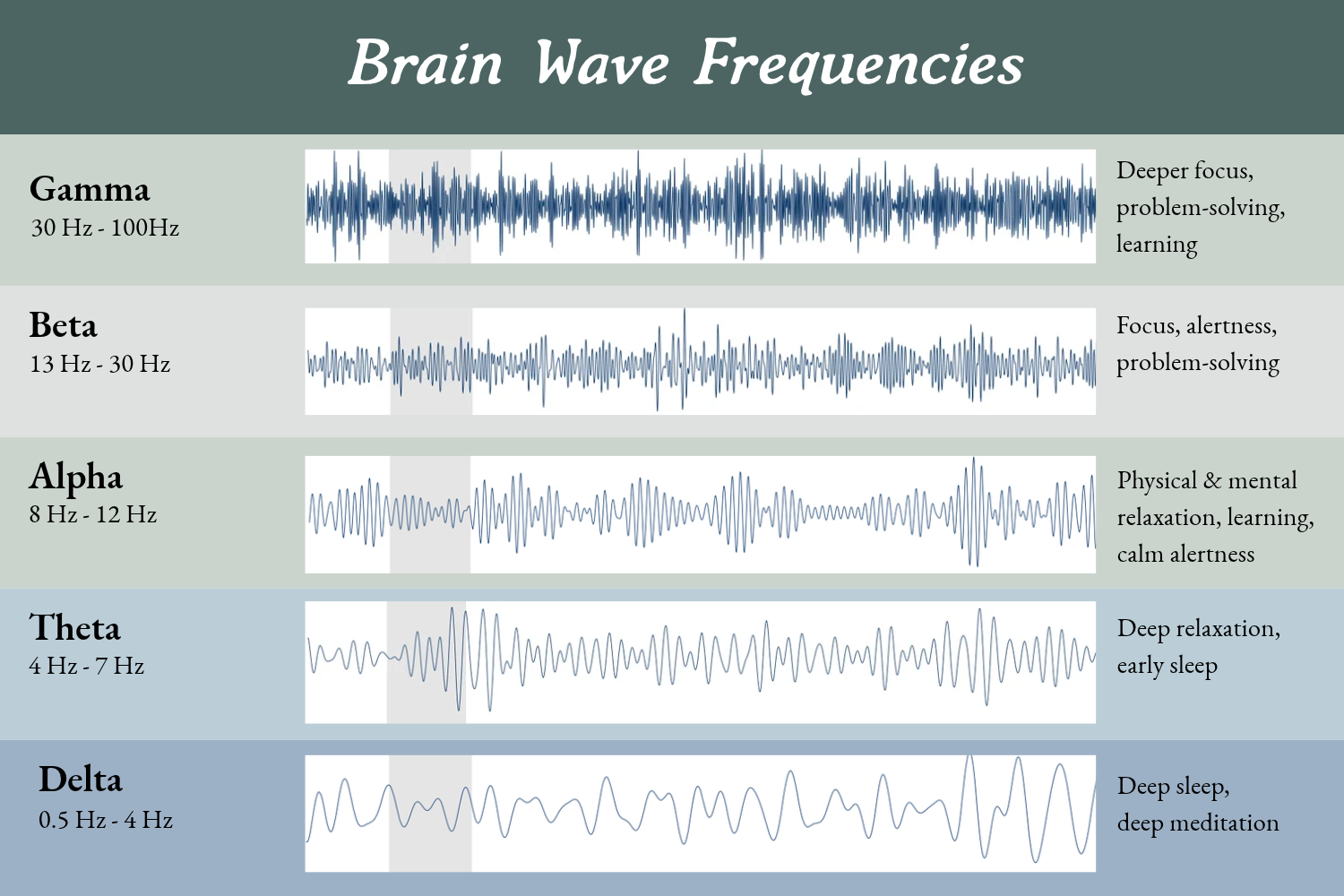
Waveform image credit: Laurens R. Krol, EEG Brainwaves, Wikimedia Commons (CC0).
Brain waves are patterns of electrical activity in the brain.
Our brains are constantly at work, with billions of neurons communicating through small electrical signals that travel along neurons and across vast networks of brain circuits. When groups of neurons become electrically active in coordinated patterns, they produce rhythmic electrical activity that can be measured as brainwaves. Think of it like a wave rippling through a crowd at a sports arena: when people begin moving in sync, the coordinated movement creates a wave. Similarly, synchronized electrical activity in the brain is what gives rise to brainwaves [9].
The five primary brainwave frequencies are: gamma, beta, alpha, theta, and delta.
All five brainwave frequencies occur at the same time, like an orchestra. As we go about our day and engage in different activities, one or more frequencies may become more prominent in our brain activity, like one section of an orchestra playing louder than the rest of the symphony.
Each brainwave frequency is associated with different mental states and patterns of activity.
Gamma waves (30 - 100 Hz): The fastest brain waves produced inside your brain. Often associated with peak concentration, intense focus, problem-solving, and processing complex information.
Beta waves (13 - 30 Hz): Associated with states of focus, concentration, alertness, critical thinking, and problem-solving.
Alpha waves (8 - 12 Hz): Associated with physical and mental relaxation, calm alertness, and relaxed learning.
Theta waves (4 - 7 Hz): Slower waves that occur during the early stages of sleep. Associated with deep meditation, deep relaxation, and light sleep.
Delta waves (0.5 - 4 Hz): The slowest brain waves, most associated with deeper sleep and deeper relaxation. They’re also thought to help with long-term memory storage during sleep.
A quantitative electroencephalogram (qEEG), or brain map, can be used to measure electrical activity in your brain. This can help identify patterns in brainwave activity and provide insight into areas of potential dysregulation.
When the nervous system is dysregulated, that means brain wave patterns can absolutely be dysregulated as well. One or more frequencies may become more prominent than we'd typically expect in certain states or activities.
For example, my brain scan came back showing higher-than-normal beta activity. While a healthy level of beta waves are important for focus and concentration, elevated activity was contributing to a pattern of overactivation, making me feel wired, anxious, like it was difficult to quiet my thoughts. This isn’t just exclusive to people with chronic illness either. In an increasingly disconnected culture, where most of us are living constantly stressed out, mental health issues are on the rise, and we’re lonelier than ever… it isn’t abnormal to see dysfunctional brain activity on some level.
So… What Exactly Do Binaural Beats Do?
Research is early and modest, but the working idea of how binaural beats work is known as “the brainwave entrainment theory” — it’s the idea that external stimulation at a certain frequency leads the brain’s electrical activity to synchronize or follow that same rhythm.
In other words, if you listen to binaural beats within a specific frequency range, the hypothesis is that it may lead your brainwaves to synchronize at the same frequency, which can influence your mental state.
The effectiveness of brainwave entrainment using binaural beats is still a subject of ongoing research. It is important to keep up to date with emerging research and to approach binaural beats as a supportive “tool” in your brain and nervous system health toolbox, rather than a standalone treatment.
Some early research has shown binaural beats may:
Significantly reduce anxiety & lower stress
Play a role in reducing pain
Improve attention & memory
Promote creativity
Support deeper sleep
Encourage meditation, mindfulness, and deeper relaxation
Findings on using binaural beats to encourage the brain towards different brainwave “states” are inconclusive. Some studies show promising results with positive changes in brain activity and cognitive performance, while other studies show little to no measurable effect.
It’s also important to remember that the effectiveness of binaural beats can vary person to person. Things like age, brain structure, cognitive state, underlying auditory processing disorders, volume, and quality of headphones may all influence how someone responds to binaural beats [13].
How to Use Them
When recommending binaural beats, I like to consider 3 things:
Your daily rhythms
Your current mental state
Your desired outcome
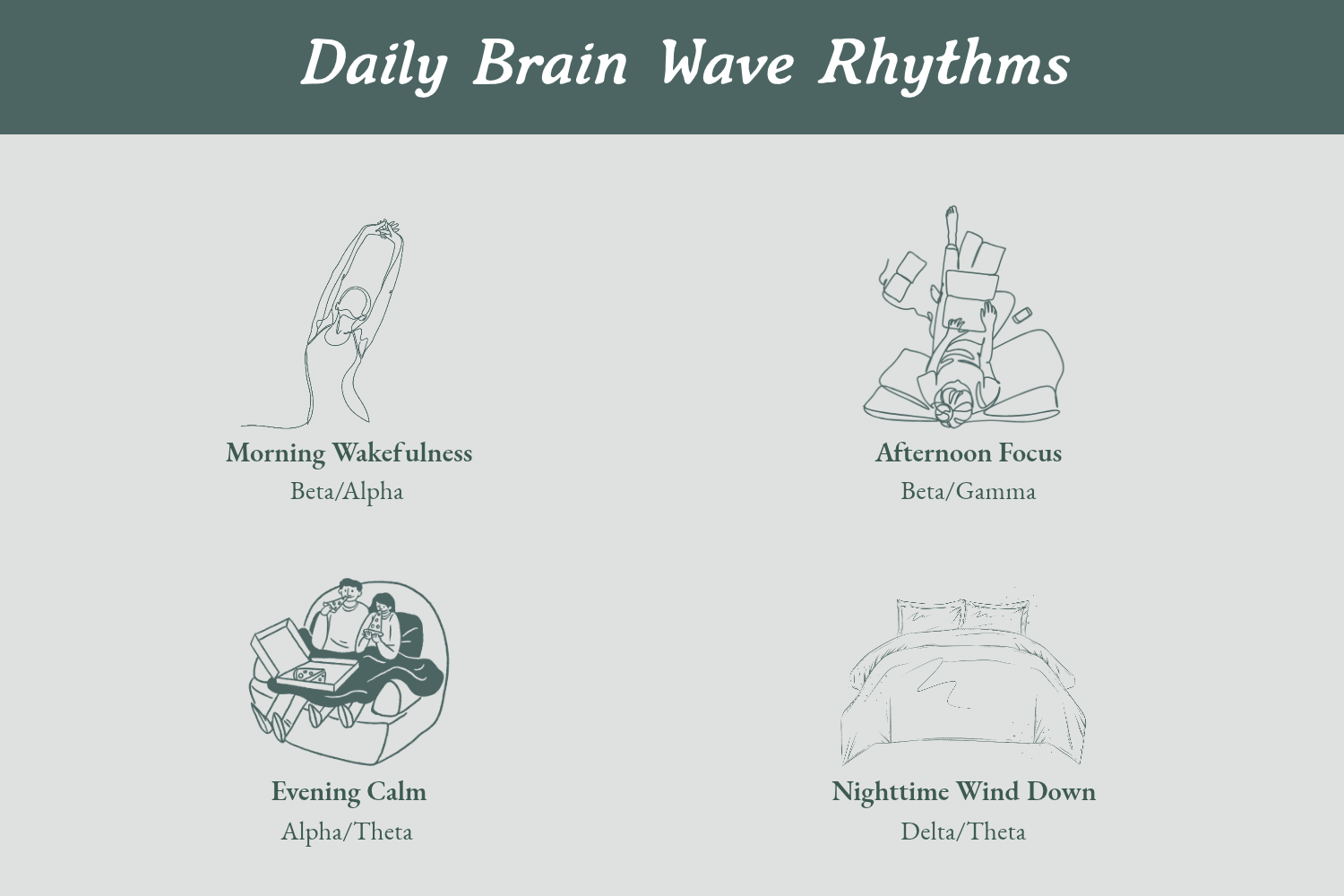
There isn’t a universal schedule of what brainwave activity looks like throughout the day, but as mentioned earlier, your brain activity naturally shifts states as you wake up, get dressed, exercise, go to work, and go about your day.
For example, beta and alpha activity are associated with morning wakefulness as you transition into an alert state. Whenever you clock in at work, beta and gamma activity may become more notable. Later in the day, as you wind down, alpha and theta activity are associated with increasingly relaxed states. Finally, theta and delta activity become more prominent as you transition into sleep.
Before choosing a binaural beat frequency, I’d consider your body’s natural rhythms throughout the day. The above graphic shows what an average person’s brainwave activity may look like throughout the day, based on what each frequency is associated with.
The idea here is that you probably don’t want to crank beta or gamma binaural beats right before bed, when your body’s rhythms need to shift more into theta or delta waves. You also wouldn’t want to listen to delta waves when you’re trying to get focused work done during the day.
After considering your daily rhythms, next I’d consider your current state and desired outcome. Here are a few examples and playlists you can listen to based on varying concerns and brain states you may want to elicit.
When to Use Alpha
Concerns: Overstimulated, anxious, wired, buzzy, racing thoughts, trouble relaxing
Desired state: Physical relaxation, mental relaxation, relaxed wakefulness, calm focus, creative flow, mental clarity
Range: 8 - 12 Hz
Most of us find ourselves stressed out and anxious, so alpha binaural beats are one of my favorite places to start with the practice. I also like that alpha binaural beats can be appropriate for most times of the day (except just before bed). It can be a great option for when you’re looking to feel relaxed, creative, and even for a calm focus during studying or work. Alpha is my personal favorite to listen to.
When to Use Beta
Concerns: Feeling sluggish, foggy, mentally fatigued, unproductive, difficulty concentrating
Desired state: Mental alertness, focus, concentration, mental energy, motivation, active thinking
Range: 13 - 30 Hz
A note before choosing Beta: Feeling sluggish, fatigued, or mentally foggy doesn't necessarily mean you need more stimulation. If you’re someone that deals with feeling stressed, overstimulated, anxious, or you suspect you may have nervous system dysregulation, a more relaxing binaural beat, like alpha, may be a better starting point for you. Sometimes fatigue or low energy can be a result of a stressed nervous system. Alpha can be helpful for some of these concerns as it is also associated with calm focus. You can always experiment and see what feels the best for you.
Beta can be a good option for listening during focused studying and working.
When to Use Delta
Concerns: Difficulty falling or staying asleep, restless sleep, difficulty achieving deep rest, difficulty switching off at night
Desired state: Deep relaxation, restorative sleep, physical recovery, feeling rested and refreshed
Range: 0.5 - 4 Hz
Delta binaural beats are a great option to experiment with when you’re struggling to fall asleep, restless at night, or wanting to create a more restful nighttime routine. This is really best to listen to right before bed or if you wake up in the middle of the night.
When to Use Gamma
Concerns: Mental fatigue, difficulty absorbing new information, struggling to make connections, difficulty thinking outside the box, difficulty with complex problem-solving
Desired State: Mentally sharp, creative, inspired, heightened cognitive engagement, enhanced learning
Range: 30 - 100 Hz
Gamma binaural beats are an interesting option when you’re looking to engage in more mentally demanding activities. If you’re learning something new, doing creative work, or complex problem-solving, this may be the option to gravitate to. Gamma is great more deeper cognitive engagement, while beta might be a better choice for every day focus and productivity.
A note before choosing Gamma: Similarly to the note on beta, feeling sluggish, fatigued, or mentally foggy doesn't necessarily mean you need more stimulation. If you’re someone that deals with feeling stressed, overstimulated, anxious, or you suspect you may have nervous system dysregulation, a more relaxing binaural beat, like alpha, may be a better starting point for you. Sometimes fatigue or low energy can be a result of a stressed nervous system. Alpha can be helpful for some of these concerns as it is also associated with calm focus. You can always experiment and see what feels the best for you.
When to Use Theta
Concerns: Difficulty unwinding, racing thoughts, mental overstimulation, difficulty quieting the mind, feeling disconnected from yourself
Desired state: Deep relaxation, focus during meditation or prayer, imagination, creative exploration, inward reflection, dreamy awareness
Range: 4 - 7 Hz
Theta is my 2nd personal favorite binaural beat to use. Both alpha and theta can be good options when you’re looking to feel calmer, but theta can be best when you’re looking to wind down at the end of the day. Theta is also worth exploring when you’re looking for a deeper relaxation (though some drowsiness may be felt), a quieter mind, and a more “meditative” state. I have listened to theta to journal, pray, and to quiet my mind/relax during the evening and have found it to be effective for my unique needs.
Considerations
Those with epilepsy or a history of seizures should consult their healthcare provider before using binaural beats. While no adverse effects have been reported, auditory stimulation may still act as a potential seizure trigger in susceptible individuals.
The individual tones (called carrier tones) playing into your left and right ear must be below 1,000 Hz for the binaural beats to work. The best perception of binaural beats occur at carrier tones between 400 and 500 Hz. Most of what you’ll find for free online may be lower than that and that’s totally fine to use!
Binaural beats require headphones to actually work. For the best experience, use stereo headphones and make sure your left and right earbuds are in the correct ears.
Keep the volume at a comfortable level.
Sit or lie in a comfortable place and listen to your chosen binaural beats audio anywhere from 5-30 minutes.
Effectiveness varies person to person. It may take time and experimentation to find the right binaural beats that suit you. You may find certain tracks effective, while others make you feel irritable, unsettled, distracted, or simply unhelpful. The above playlists are a starting place. You can always experiment with creating your own! At the end of the day, if you don’t feel that they’re effective for you, there are many other sound therapies that exist to explore.
For Those With Sensitivities
As I mentioned earlier, when I was reacting to everything at the lowest point in my health journey, binaural beats were one of the things I discussed with my healthcare practitioner to support my nervous system. Thankfully, they’re quite gentle and I personally only experienced positive effects. However, every person is different. Here are some tips to begin binaural beats if you’re someone who’d consider yourself a sensitive individual.
Start without headphones! New things (even good things) can feel threatening to an impaired limbic system. Simply playing the audio at a comfortable volume through your phone or computer can be desensitizing and help you get used to the sound. There are plenty of benefits to simply slowing down and listening to calming music as well.
Start slow. You can begin listening for 1-5 minutes and slowly work your way up to the amount of listening time that feels best to you.
Consider starting with alpha or theta. Both can be particularly supportive for those dealing with nervous system dysregulation.
Pair your listening time with a positive association. You can pray, journal, color, take a bath, do your skincare, or read while listening. Being intentional about building positive associations is a great way to build new neural pathways in your brain and can make your experience even better!
Don’t force it. Whether there’s a track that feels unsettling or you’re not enjoying listening as a whole, binaural beats either may not be for you or they’re not for you right now and that’s okay! There are plenty of things I couldn’t tolerate, but could return to and tolerate beautifully once I restored my nervous system health. Don’t be discouraged if it’s a “no” right now.
Happy listening! May your brainwaves be… well, wavy.
Reference List
Abhang, P. A., Gawali, B. W., & Mehrotra, S. C. (2016). Technological basics of EEG recording and operation of apparatus. In P. A. Abhang, B. W. Gawali, & S. C. Mehrotra (Eds.), Introduction to EEG- and speech-based emotion recognition (pp. 19–50). Academic Press. https://doi.org/10.1016/B978-0-12-804490-2.00002-6
Askarpour, H., Mirzaee, F., Habibi, F., & Pourfridoni, M. (2024). Binaural beats’ effect on brain activity and psychiatric disorders: A literature review. The Open Public Health Journal, 17. https://doi.org/10.2174/0118749445332258241008103504
Charneco, J. A. (2026). Binaural Beats. In Brain Entrainment: The Ultimate Guide to Brain Stimulation Through Sound.
Garcia-Argibay, M., Santed, M.A. & Reales, J.M. Efficacy of binaural auditory beats in cognition, anxiety, and pain perception: a meta-analysis. Psychological Research 83, 357–372 (2019). https://doi.org/10.1007/s00426-018-1066-8
Hopper, A. (2026, March 6). Nervous System Dysregulation. Retraining the Brain. https://retrainingthebrain.com/blogs/nervous-system-dysregulation
Ingendoh, R. M., Posny, E. S., & Heine, A. (2023). Binaural beats to entrain the brain? A systematic review of the effects of binaural beat stimulation on brain oscillatory activity, and the implications for psychological research and intervention. PloS one, 18(5), e0286023. https://doi.org/10.1371/journal.pone.0286023
Mantini, D., Perrucci, M. G., Del Gratta, C., Romani, G. L., & Corbetta, M. (2007). Electrophysiological signatures of resting state networks in the human brain. Proceedings of the National Academy of Sciences of the United States of America, 104(32), 13170–13175. https://doi.org/10.1073/pnas.0700668104
Melnichuk, A., Cooper, R.K. & Hawk, L.W. A parametric investigation of binaural beats for brain entrainment and enhancing sustained attention. Sci Rep 15, 4308 (2025). https://doi.org/10.1038/s41598-025-88517-z
Muse Team. (2018, June 25). A Deep Dive Into Brainwaves: Brainwave Frequencies Explained. https://choosemuse.com/blogs/news/a-deep-dive-into-brainwaves-brainwave-frequencies-explained-2/
Naviaux R. K. (2020). Perspective: Cell danger response Biology-The new science that connects environmental health with mitochondria and the rising tide of chronic illness. Mitochondrion, 51, 40–45. https://doi.org/10.1016/j.mito.2019.12.005
Nayak, C. S., & Anilkumar, A. C. (2025). Normal EEG waveforms. In StatPearls. StatPearls Publishing. https://www.ncbi.nlm.nih.gov/books/NBK539805/
Orozco Perez, H. D., Dumas, G., & Lehmann, A. (2020). Binaural beats through the auditory pathway: From brainstem to connectivity patterns. eNeuro, 7(2), ENEURO.0232-19.2020. https://doi.org/10.1523/ENEURO.0232-19.2020
Pereira, C. (2025). Understanding Binaural Beats: Healing Power of Sound - Your Brain Has A Rhythm. Learn to Tune It.
Xiong, J., Jiang, X., Cai, B., Zhao, L., Zhang, Q., & Luo, J. (2025). Binaural beats for perioperative anxiety and pain: A systematic review and meta-analysis. Complementary therapies in medicine, 95, 103299. https://doi.org/10.1016/j.ctim.2025.103299