Have you ever rearranged a space in your home, got up the next morning, went to reach for what you needed without thinking about it… only to realize your life-giving coffee grounds aren’t where they had been because you just moved them the day before?
Or have you ever started a new job and noticed that a task takes you twice as long to complete as it does your seasoned coworker?
Both of these experiences offer a glimpse into one of the brain's most remarkable abilities: neuroplasticity.
Let's take a closer look at what's happening behind the scenes in these scenarios.
What is Neuroplasticity?
Neuroplasticity refers to your brain’s ability to change its own structure and functioning in response to activity and experiences [1]. In other words, the thoughts, emotions, behaviors, and experiences you have all influence your brain function.
This is a pretty big deal because for much of the twentieth century, the mainstream view was that the brain could not change. Scientists believed the brain was “hardwired” and unchanging no matter what rehabilitation or environmental influence was applied [2].
It’s really good news because it means you’re not stuck with the brain you currently have. If there is dysfunction or damage, it means restoration and healing are possible.
But how exactly does this work?
How Your Brain Changes
The nervous system is an intricate network of billions of neurons (nerve cells). It’s organized into two main groups:
Central Nervous System: The brain & spinal cord
Peripheral Nervous System: All nervous tissue outside the CNS
Its main job is to communicate information from one part of the body to another. This happens when neurons communicate “messages” to each other via nerve impulses. These messages travel through the nervous system as electrical signals, allowing the brain, spinal cord, and rest of the body to communicate [3].
The nervous system is responsible for regulating:
Brain growth & development
Sensations (such as touch or hearing)
Perception (the mental process of interpreting sensory information)
Thought & emotions
Learning & memory
Movement, balance, & coordination
Sleep
Healing & rehabilitation
Stress & the body’s responses to stress
Aging
Breathing & heartbeat
Body temperature
Hunger, thirst, & digestion
Puberty, reproductive health, & fertility
When we refer to the brain’s plasticity, we’re specifically talking about changes in the structure and organization of neural tissue. Connections between neurons (called synapses) can strengthen or weaken, new connections can form, and existing neural pathways can reorganize. Brain maps, the larger areas of the brain responsible for processing information from or controlling different parts of the body, can change as well, allowing certain areas to expand or reorganize [5].
This process of “rewiring” your brain by forming new neural connections and weakening old ones (pruning) is neuroplasticity happening in action.
Functional vs. Structural Plasticity
There are two main types of neuroplasticity:
Functional plasticity. This involves changes in how the brain functions and operates. This can include changes in patterns of brain activity, how different brain regions communicate with one another, and how the brain processes information.
Structural plasticity. This involves changes to the brain’s physical structure. This can include strengthening or weakening of connections between neurons, the formation of new connections, and changes in neural pathways.
An analogy that helps me understand this concept is that structural plasticity is like a road. It involves neural pathways and connections that make up the brain's neural networks. Functional plasticity is like a map. It involves how the brain uses those pathways, routes information, and coordinates different regions to accomplish tasks.
The Principles of Neuroplasticity
Neuroplasticity is simply the brain’s ability to change. It is a phenomenon that occurs without necessarily being “good” or “bad”. The brain can change in maladaptive ways (trauma, addiction) or in beneficial ways (forming good habits, learning, recovering from injury).
However, understanding how neuroplasticity works can help you use your brain’s adaptability to your advantage to support its health and function.
Researchers Kleim and Jones (2008) identified 10 principles of neuroplasticity to be aware of to improve brain function, support recovery, and promote lasting changes:
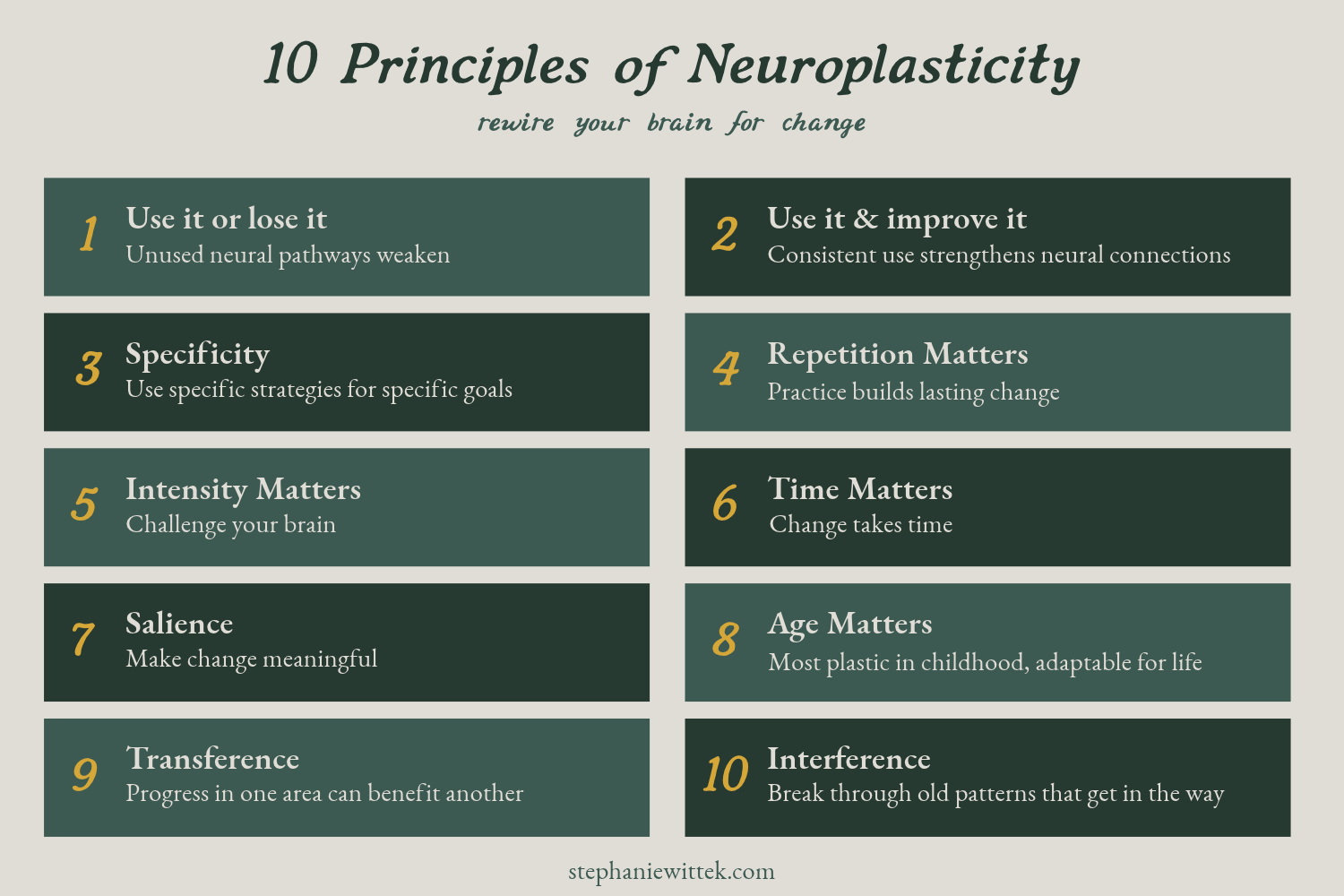
1. Use it or lose it. Neural connections lose strength when they’re not being used. Just like muscles weaken when you don’t exercise, neural pathways weaken when they’re not being used.
2. Use it and improve it. Neural connections grow stronger when they are used consistently. The more you think a thought, practice a skill, or perform an action, the easier it’ll be to keep doing it. Practice makes progress.
3. Specificity. Your brain needs specific exercises to achieve specific goals. To promote lasting neuroplastic changes, you need to use targeted activities, therapies, or practices that address the particular skills or functions you want to improve.
4. Repetition matters. Repetition is required for long-term changes in the brain. The more you practice something, the more proficient you can become. Consistency is key and practice makes “permanent”.
5. Intensity matters. Like repetition, intensity plays an important role in long-term neuroplastic change. Just like you need to challenge your muscles to build strength, you need to challenge your brain to see meaningful changes. Intensity can refer to how often you do an exercise, how long you do it, or how difficult it is. The goal is to challenge yourself while still respecting your limits.
6. Time matters. It takes time for the brain to change. Time and repetition are important for weakening old neural pathways and strengthening new ones. After an injury, the timing of rehabilitation can also influence recovery. Even when therapy or rehabilitation begins later, improvement can still be possible.
7. Salience matters. You’ll see better results when what you’re doing matters to you. If you’re not enjoying a particular exercise, you can simply try one that’s a better fit for you.
8. Age matters. Our brains are especially adaptable when we're children, but you can continue to grow, learn, and adapt at any age and stage of life.
9. Transference. Learning or improving a skill in one area of the brain can help improve other skills or abilities. Training a skill can sometimes activate nearby pathways. Transference can also occur when skills developed through therapy or rehabilitation carry over into everyday activities.
10. Interference. Old habits and established patterns can sometimes interfere with positive changes you're trying to make. It may take more effort to unlearn familiar patterns and develop new ones to see improvements in your physical or emotional health.
The Benefits of Neuroplasticity
So, what exactly does all of this mean for you? Neuroplasticity specifically plays a role in:
Learning new skills & information
Developing habits & changing behavioral patterns
Enhancing brain function & cognitive health
Improving & maintaining memory
Recovering from brain injury or neurological conditions
Adapting to new experiences and environmental changes
Understanding neuroplasticity gives you a better understanding of how your everyday experiences, habits, and activities shape your brain and how you can be more successful with the changes you want to make.
Want to learn a new language? You can use the principles of specificity, repetition, and intensity to guide your practice.
Want to develop a healthier habit? Understanding how neural pathways strengthen through repeated use or finding ways to make your habit meaningful (salience) to you can set you up for success as you build it.
Want to change an established behavior or thought pattern? Time, repetition, and finding the right targeted approach (specificity) can all help you make these changes in the long-term.
A note for those with complex chronic illness: Nervous system dysregulation can be a hallmark for those with long-term, unexplained health symptoms. In some ways, we could almost view this as a brain “injury” or impairment. Thankfully, neuroplasticity has a role to play in these cases too. Brain retraining or “rewiring” exercises and programs exist to support the brain and body in restoring healthy nervous system functioning, which in turn can stabilize and support the rest of the body.
Lifestyle Strategies to Enhance Neuroplasticity
There are so many ways we can support our brain’s health and ability to change. We’ve already learned that neuroplasticity plays a role in learning, forming new habits, our thought patterns, & even recovering from injury. Research shows us there are a few lifestyle factors that influence neuroplasticity and brain health that you can start implementing today.
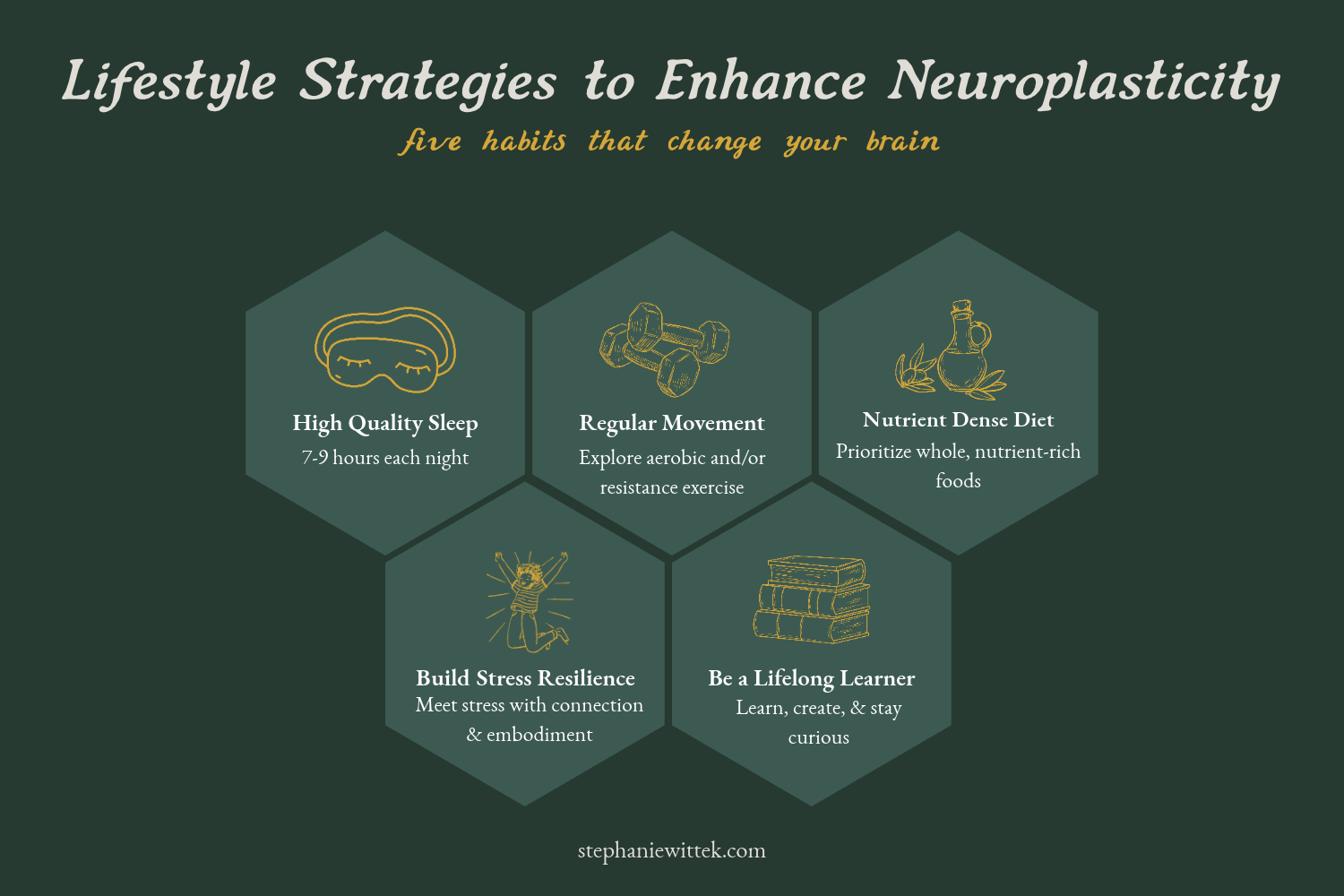
1. Get high quality sleep.
Sleep plays a large role in learning, memory consolidation, and other neuroplastic processes. Aim for 7-9 hours of sleep each night to support your brain's ability to rest, recover, and adapt.
For even better quality sleep, a consistent nighttime routine can help establish a rhythm that prepares your body for sleep each night. You can aim to go to bed around the same time each night, eliminate as much light as possible, or try listening to binaural beats before bed to help reinforce healthier sleep-wake rhythms.
2. Move your body regularly.
Making movement a habit is one of the best ways to support your brain health and promote neuroplasticity. Aerobic and resistance exercise, specifically, offer several cognitive benefits and combining the two may enhance those even more.
Aerobic Exercise: Walking, running, cycling, swimming, jogging, dancing, jumping rope, stair climbing, hiking, skating, recreational sports, active household chores, active games
Aerobic activities get your heart pumping, increase blood flow to the brain, and support the production of brain-derived neurotrophic factor (BDNF), a protein that plays an important role in learning, memory, and the growth and maintenance of neurons.
Resistance Exercise: Bodyweight exercises (pushups, squats, lunges, planks, pull-ups), strength training (dumbbells, barbell, kettlebell), resistance bands, pilates, barre, calisthenics
Resistance exercises help strengthen the neural connections involved in muscle control and support cognitive function.
Research suggests that engaging in physical activity before learning or practicing a new skill can actually improve learning and memory, so you may want to try exercise or engaging in some sort of movement before diving into learning or practicing a new skill. The U.S. Department of Health and Human Services recommends working up to 150 minutes of moderate-intensity aerobic activity each week, along with muscle-strengthening activities at least twice a week. You can break this up throughout the week and slowly work up to your body’s current ability. Even if you can’t tolerate the “standard” amount of exercise, some movement is better than none.
3. Focus on a nutrient dense, whole foods diet.
The food you eat becomes fuel for your body and diet can affect neuroplasticity and overall brain health. Research suggests that certain dietary patterns, such as the Mediterranean diet, may help preserve the structure and connectivity of brain circuits involved in learning, memory, and cognitive function [10].
A Mediterranean-style diet is rich in vegetables, fruits, legumes, nuts, whole grains, fish, and healthy unsaturated fats. Nutrients and plant compounds like omega-3 fatty acids, catechin polyphenols, and curcumin have also been studied for their role in supporting cognitive function and protecting brain health.
4. Build stress resilience.
Stressors are part of life and aren’t inherently bad, but prolonged stress can alter BDNF expression in brain regions involved in learning, memory, and emotional regulation and impair beneficial neuroplastic changes.
A few simple, sustainable habits you can include in your day to reduce stress:
Pray & meditate on Scripture
Listen to worship music or calming music
Practice gratitude daily
Practice slow, intentional breathing (you can incorporate breath prayer here too)
Spend time outside or in nature
Connect with others - we weren’t made to do life alone!
Somatic experiencing practices or vagus nerve exercises
Practice mindfulness, take breaks when needed, and set appropriate boundaries
5. Be a lifelong learner.
Keeping your mind active with focused learning of new skills or knowledge is a key part of enhancing your brain’s neuroplasticity. You can challenge your brain with something new like:
Learning a new language
Learning to play an instrument
Cooking a new recipe
Taking up a new hobby
Creating something new
Traveling (or even learning about travel spots virtually)
Studying something you’re curious about
You can also introduce variety into familiar activities by changing the order you do things, approaching a task from a different angle, or using your non-dominant hand for something simple. Sometimes, even small changes to the familiar can offer your brain a new experience. Your brain loves novelty!
Remember that learning doesn’t happen all at once and focused repetition and practice are a huge part of reinforcing neural pathways to learn and grow. Lifelong learning helps keep us engaged, curious, and mentally active.
Want to Learn More?
It is an incredible hope to know that our brains aren’t fixed and research continues to emerge showing us what is possible as a result of neuroplasticity. When I first learned about the concept of neuroplasticity, I felt a sense of wonder and awe at the way God designed the human brain and body and I had the verse Romans 12:2 come to mind: “Do not conform to the pattern of this world, but be transformed by the renewing of your mind. Then you will be able to test and approve what God’s will is—his good, pleasing and perfect will.”
I absolutely love the intersection of where science meets scripture and my prayer for you is that God would lead you through not only a renewal of your mind, but also to true wellness in mind, body, soul, and spirit. My hope is that beginning to learn more about the way God designed our big, beautiful neuroplastic brains can be a game changer on this journey for you.
If you’d like to learn more and see real life neuroplasticity in action, I’d encourage you to dive deeper into some of these resources:
The Brain That Changes Itself (2008) Documentary
Books
The Brain That Changes Itself by Norman Doidge
The Brain’s Way of Healing by Norman Doidge
Soft-Wired: How the New Science of Brain Plasticity Can Change Your Life by Michael Merzenich
Reference List
Doidge, N. (2015). The Brain's Way of Healing: Remarkable Discoveries and Recoveries From the Frontiers of Neuroplasticity. Penguin.
Taub, E. (2014). Foreword for neuroplasticity and neurorehabilitation. Frontiers in Human Neuroscience, 8, Article 544. https://www.frontiersin.org/journals/human-neuroscience/articles/10.3389/fnhum.2014.00544/full
Tortora, G. J., & Derrickson, B. (2018). Introduction to the Human Body (11th ed.). Wiley.
National Institute of Child Health and Human Development. (n.d.). What Does the Nervous System Do? National Institutes of Health. https://www.nichd.nih.gov/health/topics/neuro/conditioninfo/Pages/functions.aspx
Power, J. D., & Schlaggar, B. L. (2017). Neural plasticity across the lifespan. Wiley interdisciplinary reviews. Developmental biology, 6(1), 10.1002/wdev.216. https://doi.org/10.1002/wdev.216
Galván A. (2010). Neural plasticity of development and learning. Human brain mapping, 31(6), 879–890. https://doi.org/10.1002/hbm.21029
Kleim, J. A., & Jones, T. A. 2008. Principles of experience-dependent neural plasticity: Implications for rehabilitation after brain damage. Journal of Speech, Language, and Hearing Research, 51, S225–S239. https://pubs.asha.org/doi/10.1044/1092-4388(2008/018)
Marzola, P., Melzer, T., Pavesi, E., Gil-Mohapel, J., & Brocardo, P. S. (2023). Exploring the Role of Neuroplasticity in Development, Aging, and Neurodegeneration. Brain sciences, 13(12), 1610. https://doi.org/10.3390/brainsci13121610
Hirshkowitz, M., et al. (2015). National Sleep Foundation’s sleep time duration recommendations: methodology and results summary. Sleep Health, 1(1), 40–43. https://doi.org/10.1016/j.sleh.2014.12.010
Pickersgill, J. W., Turco, C. V., Ramdeo, K., Rehsi, R. S., Foglia, S. D., & Nelson, A. J. (2022). The Combined Influences of Exercise, Diet and Sleep on Neuroplasticity. Frontiers in psychology, 13, 831819. https://doi.org/10.3389/fpsyg.2022.831819
Miao, Z., Wang, Y., & Sun, Z. (2020). The Relationships Between Stress, Mental Disorders, and Epigenetic Regulation of BDNF. International journal of molecular sciences, 21(4), 1375. https://doi.org/10.3390/ijms21041375
Duman R. S. (2004). Neural plasticity: consequences of stress and actions of antidepressant treatment. Dialogues in clinical neuroscience, 6(2), 157–169. https://doi.org/10.31887/DCNS.2004.6.2/rduman
Affiliate Disclaimer: Please know that some of the links provided are affiliate links and I do receive a small commission if you make a purchase using these links. This comes at no extra cost to you when you make a purchase. I very much appreciate your support of this website in doing so!